
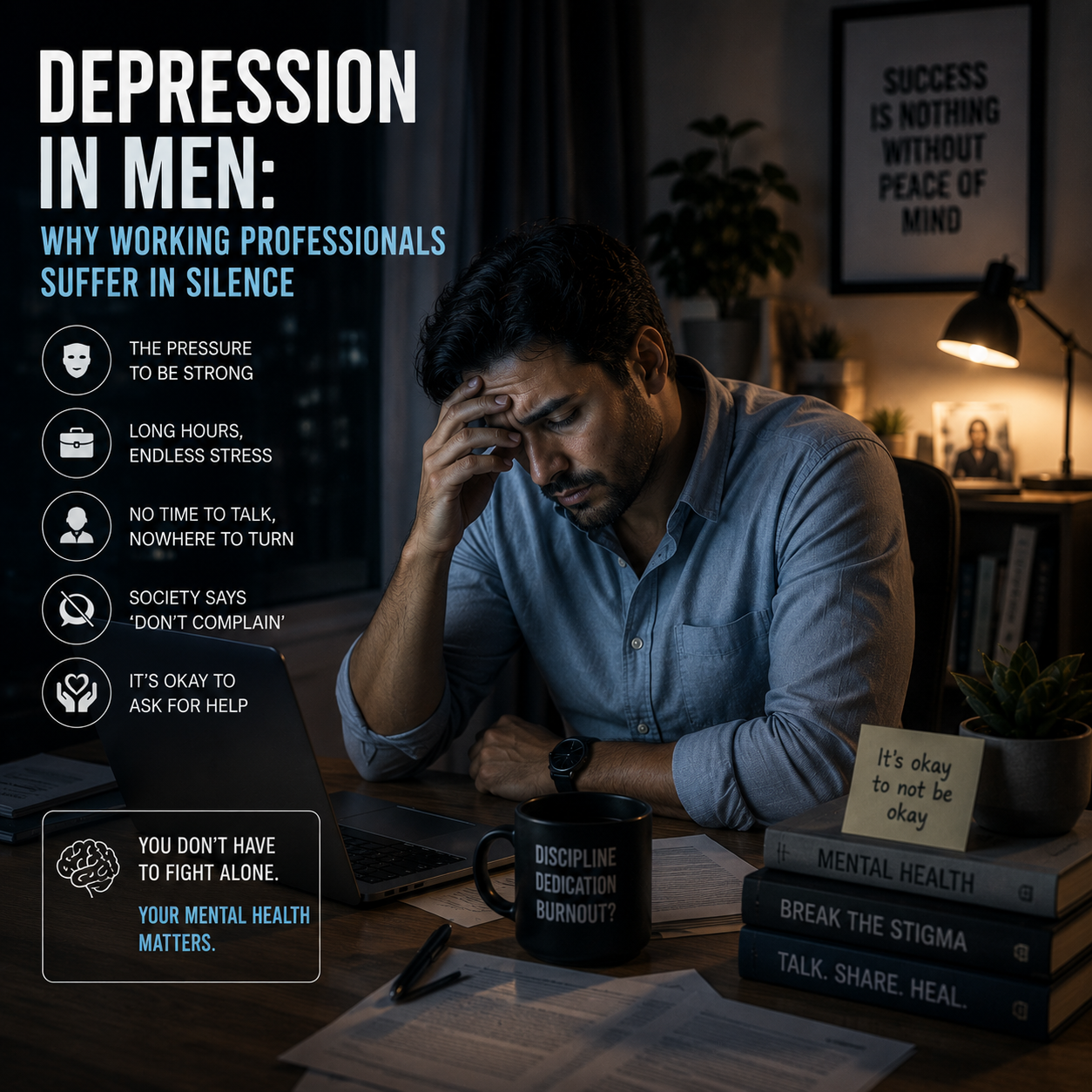
Depression in Men: Why Working Professionals Suffer in Silence
What Does Depression in Men Actually Look Like?
The traditional picture of depression sadness, withdrawal, hopelessness often does not match how men experience the condition. Mental health professionals have consistently observed that depression in men tends to wear a different mask.
Depression in men looks nothing like what most people imagine. It does not always arrive as tears or visible despair. For millions of working men across India, it shows up as bone-deep fatigue that sleep cannot fix, as short temper that strains every relationship, as a quiet numbness that makes getting through the workday feel impossible. Yet the unspoken rule in most workplaces and in most homes remains the same: show up, perform, never admit that you are struggling. This silence is not just painful. For many men, it is fatal.
What Does Depression in Men Actually Look Like?
The traditional picture of depression sadness, withdrawal, hopelessness often does not match how men experience the condition. Mental health professionals have consistently observed that depression in men tends to wear a different mask. Instead of expressing sadness, men frequently show heightened irritability, anger, and hostility. Rather than withdrawing quietly, they may throw themselves obsessively into work, using professional achievement as a wall against emotional pain.
Clinical psychologists at Well Hope have noted a sharp rise in anxiety, OCD, and depression, particularly among men between the ages of 25 and 40. The pressure to perform, to provide, and to succeed sits heavily on this demographic and the symptoms it produces are rarely recognised as depression by the men experiencing them or by those around them.
Common Signs of Male Depression That Go Unnoticed
• Persistent irritability or rage, often without a clear cause
• Overworking as a way of avoiding internal pain
• Unexplained physical symptoms such as headaches or back pain
• Increased alcohol consumption or risky behaviour
• Emotional numbness or a sense of disconnection from life
The Workplace: Where Depression in Men Grows Quietly
Modern Indian workplaces have become environments where depression in men can deepen undetected. The India Workplace Wellbeing Report 2025 found that 78 per cent of employees describe their work environment as stressful due to high expectations and peer pressure. Nearly 40 per cent of professionals cite poor work-life balance as the primary factor damaging their mental health, followed closely by micromanagement.The economic consequences are staggering. Absenteeism costs Indian corporations an estimated USD 8.5 billion annually. Presenteeism when employees show up for work while mentally unwell costs an additional USD 158 billion in lost productive days. These figures are not just corporate statistics. Behind each one is a person dragging themselves through a workday while something inside them quietly breaks.
Why Men Fear Asking for Help at Work
A survey of nearly 20,000 Indian professionals found that 31 per cent feared voicing mental health concerns because they might be seen as incapable. Three in four professionals remain hesitant to disclose taking time off for mental health, preferring to call it general sick leave. This fear is not irrational workplaces that reward relentless productivity and penalise perceived weakness give men very little room to be honest about what they are experiencing.
The Stigma That Silences Men
Perhaps the greatest barrier is not biological or systemic it is cultural. Approximately 40 per cent of Indian men do not openly discuss their mental health, largely because of deeply ingrained beliefs that men should handle their emotions independently. Psychiatrist Dr Shyam Bhat explains that current diagnostic systems can easily miss depression in men precisely because men rarely present with textbook sadness. Instead, they experience physical pain, anger, and numbness symptoms that do not always register as depression to a physician or to the man himself.The consequences of this silence are not abstract. Men die by suicide in India at a rate 2.5 times higher than women a devastating statistic that exists alongside the fact that women are diagnosed with depression more frequently. The gap between diagnosis and lived suffering for men could not be wider.
Does Counselling Work for Depression in Men?
The evidence is clear: depression in men is treatable, and professional counselling works. Cognitive Behavioural Therapy has demonstrated consistent effectiveness in reducing depressive symptoms among working populations, with improvements that persist well beyond the therapy period. Randomised controlled trials show effect sizes ranging from moderate to large, with gains maintained at follow-up assessments. Well Hope has proven again and again with numerous testimonials and successful cases that counseling for depression in men work.
For men who find traditional therapy settings uncomfortable, alternatives show real promise. Walk-and-talk therapy, telephone-based sessions, and internet-delivered interventions have all demonstrated effectiveness especially because they offer confidentiality and flexibility. Behavioural activation approaches, which focus on concrete action rather than emotional processing, tend to resonate particularly well with men who are sceptical of talking therapies.
Data from NHS Talking Therapies shows that 92 per cent of male patients who completed therapy reported receiving the help they needed. Work-focused CBT programmes have reduced sick leave among participants from 79 per cent to 32 per cent in just 12 weeks. The outcomes for men and women, when both access appropriate care, are comparable.
How to Take the First Step
If you recognise yourself in any of this the exhaustion that does not lift, the irritability that surprises even you, the sense that something is quietly wrong you are not weak for noticing it. You are paying attention. Depression in men does not disappear by being ignored. It deepens.A mental health check-in deserves the same consideration as a physical health check-up. Seeking support from a counsellor or therapist is not a sign of failure it is a deliberate act of self-awareness. The professional who hesitates to make that first appointment is not failing. They are taking the first courageous step toward recovering themselves.There is professional help available and asking for help is a way to help yourself. Reach out to Well Hope and meet certified therapists.
You are not alone, Well Hope is with you
If you are a working professional in India experiencing any of the signs discussed above, consider speaking with a trained philosophical counsellor or therapist who understands the specific pressures men face. Early support makes recovery faster, deeper, and more lasting.
Book a confidential session. Reach out on WhatsApp or connect via the contact form below.
