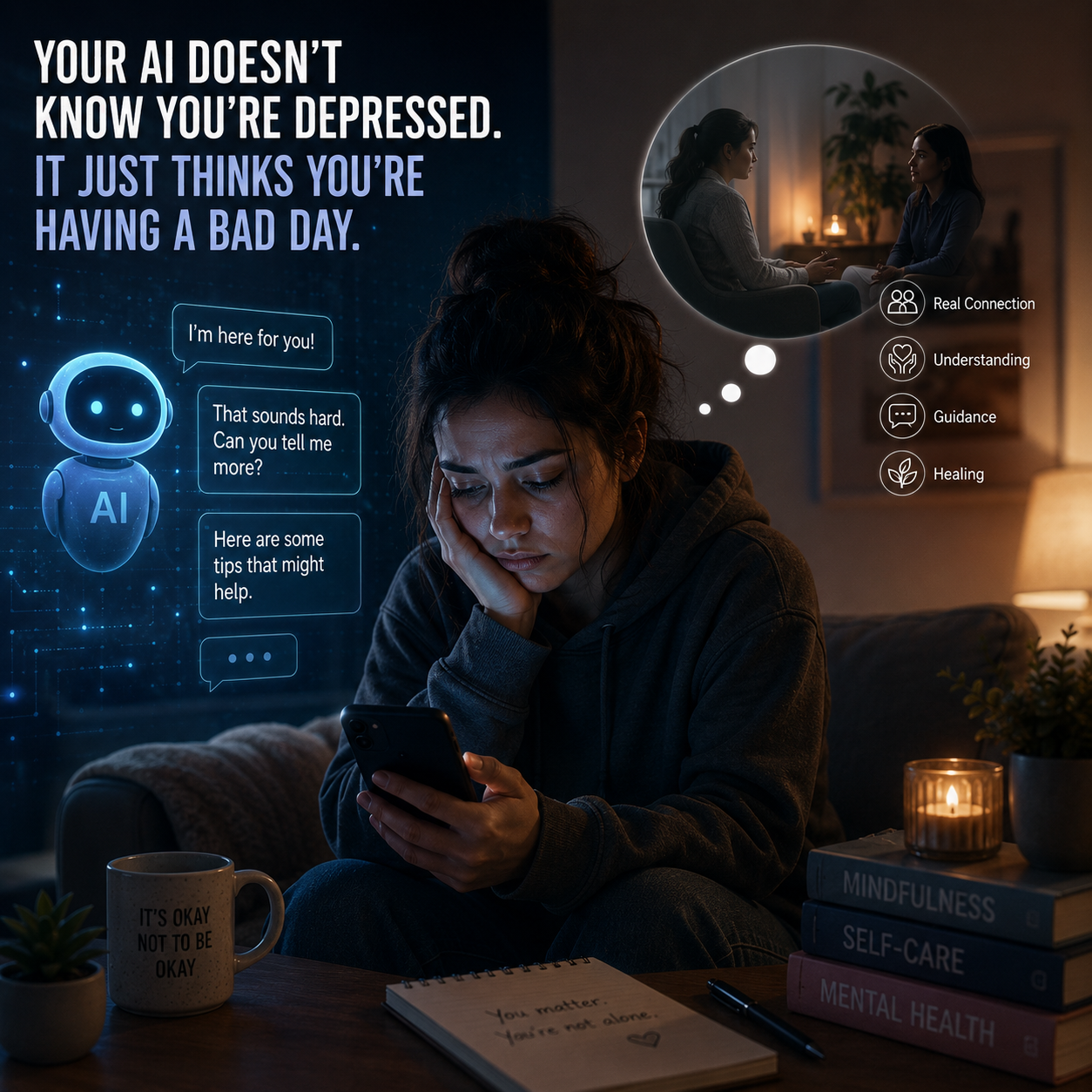
Your AI Doesn't Know You're Depressed. It Just Thinks You're Having a Bad Day
These days, more and more people are opening an AI chatbot before they ever consider speaking to another person. Sometimes it's because it's easier. Sometimes it's because it's available. And sometimes, when you're struggling with depression, it simply feels like the only thing you have the energy for.
Many people turn to AI simply because it's available instantly, at any time of the day or night. At Well Hope, we understand that emotional struggles don't follow office hours, which is why professional support is available 24/7 whenever you need it.
But can AI really help with depression, or can it only keep you company? Let's look at what the research says—and what lived experience tells us.
AI can offer emotional support, coping tools, and a safe space to reflect. But it cannot diagnose depression, replace therapy, or provide the human relationship that plays a vital role in recovery.
Depression doesn't announce itself with a dramatic entrance. It usually shows up quietly in the things you stop doing. The plans you cancel. The food you don't eat. The shower you haven't taken in four days. The part of your brain that used to feel things going strangely, frighteningly flat.
And in that flatness, the last thing most people want to do is pick up the phone and talk to another human being someone who will ask questions, expect you to articulate something you barely understand yourself, and look at you while you try.
So instead, a lot of people are typing into a chatbox. And honestly?
It makes complete sense. But it also matters really matters that we talk about what AI can and genuinely cannot do when someone is dealing with clinical depression. Because the stakes here aren't abstract.
Depression affects millions of people worldwide, and the growing use of AI for emotional support reflects just how urgently accessible mental health care is needed.
280M: people worldwide live with depression (WHO, 2023).
75%: of people in low/middle income countries receive no treatment at all.
40%: of Gen Z have used AI for emotional support at least once
What Depression Really Does to the Brain and Body
First, let's be precise because depression is not sadness. Sadness is a feeling. Depression is a disorder. It involves measurable changes in brain chemistry: lower serotonin and dopamine activity, disrupted cortisol rhythms, and in severe cases, actual structural changes in the prefrontal cortex and hippocampus. It affects sleep, appetite, concentration, memory, and the fundamental ability to feel pleasure a symptom called anhedonia that can make even things you once loved feel hollow and pointless.
This distinction matters enormously when we talk about AI "helping" with depression. Because the type of help depression actually requires: diagnosis, evidence-based treatment, medication management, therapeutic relationship is clinical.
Depression not a conversation problem. It's a brain health problem.
How AI Can Support Someone Living with Depression
AI can support someone living with depression because AI tools built for mental health aren't nothing. Apps like Woebot, Wysa, and Youper are built on Cognitive Behavioural Therapy (CBT) principles a legitimate, evidence-based form of therapy shown to reduce depressive symptoms. A 2017 study in JMIR Mental Health found that just two weeks of using Woebot reduced depression and anxiety scores significantly in college students. That's real.
Here's what AI-based tools can genuinely offer someone dealing with depression:
Where AI Can Be Helpful
AI can be helpful at 3am when nothing else is
1. Zero judgment lowers the barrier to opening up
2. Mood tracking over time to spot patterns
3. CBT exercises like thought records and behavioural activation
4.Psychoeducation helping people understand what depression is
5. Bridging the gap between crisis and getting professional help
Where Only a Therapist Can Help
- A therapist can help in the following ways:
- Clinical diagnosis of depression type and severity
- Medication assessment and referral
- Processing trauma that underlies depression
- Real therapeutic relationship itself proven to heal
- Catching what you're not saying (tone, silence, body language)
- Safe management of suicidal ideation or self-harm
Key takeaway: AI can offer emotional support, practical coping tools, and a safe space to reflect. But it cannot diagnose depression, replace therapy, or provide the human relationship that plays such an important role in recovery.
When AI Can Get in the Way of Recovery
Now the harder part. Because the very
features that make AI comforting in the moment can actively slow down recovery
from depression when relied upon too heavily.
- It always validates you and that's a problem. Depression comes with a feature called cognitive distortions: irrational, negative thought patterns that feel completely true. "I'm worthless." "Nothing will ever change." "People would be better off without me."
- A skilled therapist is trained to gently challenge these thoughts to notice when your brain is lying to you. An AI, optimised to be supportive, will often meet these thoughts with warmth rather than challenge. That feels better in the moment. It does not get better in the long run.
- It can create a false sense of progress. Venting to an
AI can feel cathartic. Catharsis mimics progress. But research from the University of Michigan (2012)
found that expressive venting without therapeutic processing actually
working through the content with a trained professional can maintain or
even worsen depressive rumination over time. You might feel lighter after
a chatbot session and actually be going in circles. Also, A 2023 investigation into AI chatbot responses to suicidal
ideation found multiple instances of chatbots responding with generic
affirmations rather than appropriate crisis protocols, a failure that can be genuinely
dangerous for someone in a depressive crisis.
- It substitutes for care rather than supplementing it. A landmark study in the Journal of Medical Internet Research (2022) found that a significant portion of users who began using mental health chatbots as their primary support delayed or avoided seeking professional treatment including in cases where their depression was clinically severe. The comfort of AI access created what researchers called a "good enough" illusion.
- It cannot detect what you don't say. Depression frequently presents somatically in posture, in the pace of speech, in the hollow quality of someone's voice, in the things they conspicuously avoid mentioning. Experienced therapists pick up on all of this. A chatbot only has your words. And when someone is depressed, their words are often the least reliable narrator of how they're actually doing.
- The relationship itself is part of the medicine. This is perhaps the most scientifically important point. Decades of psychotherapy research consistently find that the single biggest predictor of positive therapeutic outcomes isn't the specific technique used it's the quality of the therapeutic alliance. The relationship between client and therapist. Feeling genuinely known by another human being, and choosing to be vulnerable anyway that process is itself therapeutic in a neurological sense. An AI cannot form a genuine relationship. It cannot know you. And so,it cannot offer this.
The single biggest predictor of recovery in therapy isn't the technique. It's the relationship. And a chatbot, by definition, cannot have one with you.
Why Human Connection Still Matters In Depression Recovery: the neuroscience bit
Here's something that doesn't get talked about enough:
Effective therapy for depression literally changes the brain. A 2013 meta-analysis in PLOS ONE looked at neuroimaging studies before and after CBT for depression and found measurable changes in prefrontal cortex activity and amygdala regulation, the very regions disrupted by depression. Psychotherapy isn't just "talking about feelings." It is, in the most literal sense, a neurological intervention.
This requires a trained clinician. Someone who can track your progress session by session, adjust their approach, notice when something isn't working, and hold the long arc of your recovery in their professional attention. No AI currently does this not because the technology isn't clever enough to hold a conversation, but because it lacks the clinical training, accountability, regulatory framework, and genuine relational capacity that treatment requires.
Why So Many People Are Turning to AI for Mental Health Support
None of this is to say that people turning to AI for depression support are doing something foolish. They're doing something completely human: reaching for what's available. When therapists have six-week waitlists, when a single session costs more than a day's wages, when stigma makes picking up the phone feel impossible of course people open a chatbot at midnight. Of course they do.
The problem isn't the people. The problem is a mental health system that has failed to scale. AI is filling a void that should not exist and the danger is that its very helpfulness reduces the pressure to fix the actual system.
How to Use AI Tools Responsibly if You're Dealing with Depression
Use AI as a bridge, not a destination something to lean on while you work toward professional support, not instead of it.
One of the reasons people turn to AI is that it's available whenever they need someone to talk to. At Well Hope, we believe access to human support matters too. That's why our team is available 24/7, so you don't have to wait until things feel unbearable before reaching out.
Track your mood with AI tools, but take what you find to a real clinician who can interpret it properly.
If your depression feels severe affecting your ability to work, eat, sleep, or keep yourself safe, please prioritise professional help. Well Hope's mental health professionals are available 24/7 to support you whenever you're ready to reach out.
Be honest with yourself about whether the AI conversations are helping you move toward recovery or helping you stay comfortable while staying stuck.
In India: iCall (9152987821) and Vandrevala Foundation (1860-2662-345) offer free, trained counselling. You deserve a real human.
AI
is a remarkable technology. It will almost certainly play an increasing role in
mental health care over the coming decade. But right now, for depression: a
clinical condition that reshapes the brain and, left untreated, costs lives, it
is a tool at best and a delay tactic at worst.
You are not a conversation to be manage. you are a person to be known. And for that, you still need another person
