
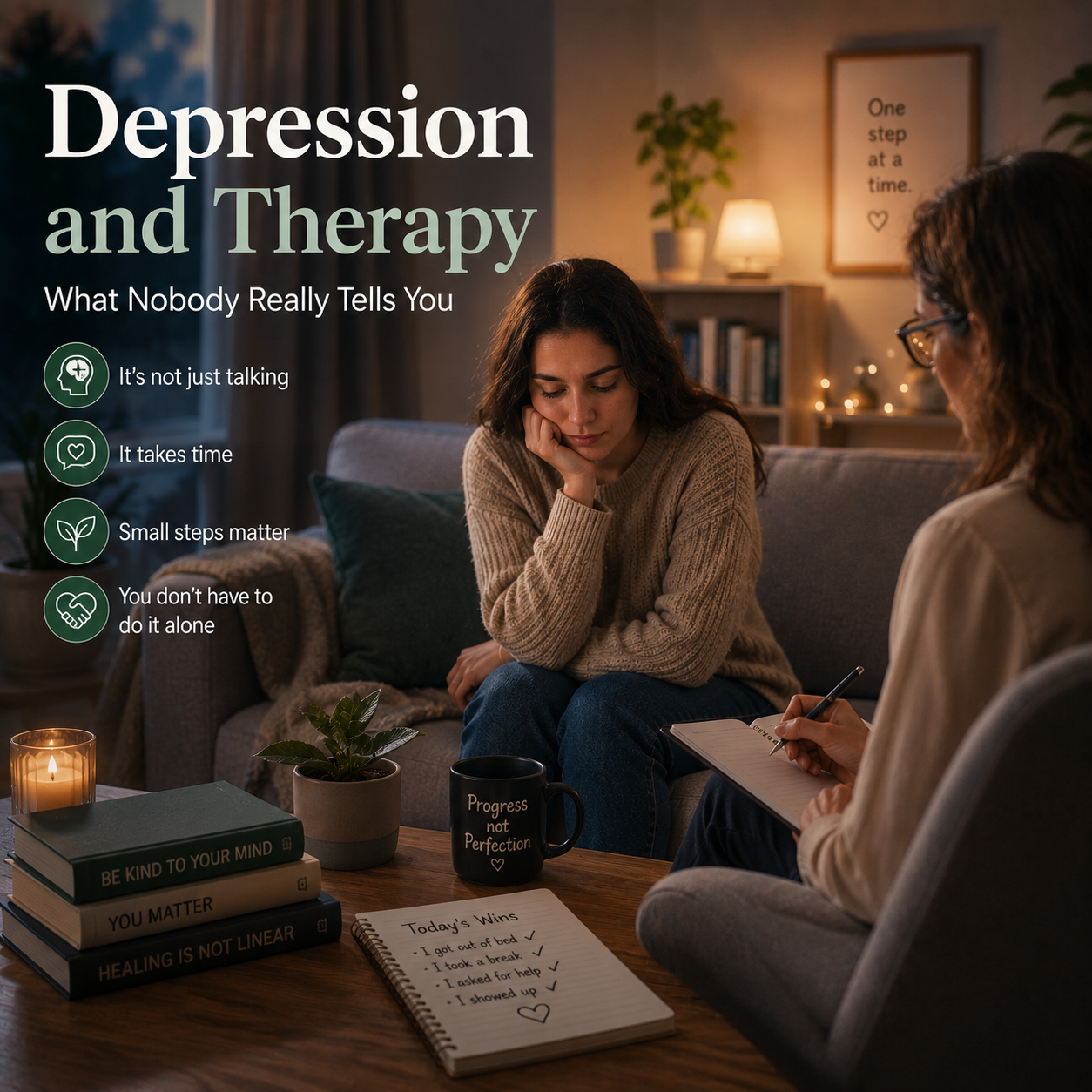
Depression and Therapy-What Nobody Really Tells You
If you're reading this while sitting on the fence about therapy and depression, stay with me. This isn't a clinical breakdown. It's just one honest guide from someone who's been through the confusion.
I'll start with something most articles won't say.
Therapy scared me. Not because I thought it was useless, but because sitting in front of someone and admitting "I'm not okay" felt like the hardest thing in the world. For a long time, I kept pushing through, telling myself I'd figure it out. Spoiler: I didn't figure it out. Things just got quieter and heavier until I finally made an appointment.
If you're reading this while sitting on the fence about therapy and depression, stay with me. This isn't a clinical breakdown. It's just one honest guide from someone who's been through the confusion.
Depression Isn't What Most People Think It Is
People picture depression as someone crying in bed all day, curtains drawn, unable to move. Sometimes it looks like that. But honestly? A lot of the time it does not.
Sometimes depression looks like someone who goes to work, replies to messages, laughs at jokes — and still feels completely hollow inside. Like you are watching your own life through glass. Present but not really there.
It creeps into small things. You stop texting people back. Foods you loved start tasting like nothing. You cancel plans and feel relieved and guilty at the same time. Getting out of bed becomes a negotiation you have with yourself every single morning.
And your body feels it too — random headaches, your stomach acting up, getting every cold that passes through your office. Depression doesn't remain confined to your thoughts alone. It spreads.
Recognizing it for what it is — not laziness, not weakness, not "just a phase" — that matters. Depression and Therapy only start working together once you stop pretending the problem isn't there.
What Therapy Actually Feels Like
Before I got into it, I imagined therapy as lying on a couch while someone asked me about my mother. That's not really how it goes.
A good therapy session feels more like finally saying things out loud that you've been carrying silently for months. Sometimes even years. There's something that shifts just in the act of putting words to something you've only ever felt.
But beyond that, therapy gives you a structure. Your therapist is not just listening to you they are helping you in connecting the dots. Why do you react in a certain way? Where did that belief about yourself come from? What habits are keeping you stuck without you even noticing?
With depression especially, that kind of guided self-examination matters. Because depression warps your thinking quietly. It convinces you that you're the problem, that it'll always be this way, that you don't deserve better. Therapy gently, persistently challenges all of that — and eventually, you start to believe the challenge more than the depression.
Different Therapies for Depression — A Real Breakdown
There isn't one universal approach. What worked for your colleague might not work for you and that's fine? Here are the main ones worth knowing about:
CBT — The Most Common Starting Point
Cognitive Behavioral Therapy basically helps you catch yourself mid-spiral. You're lying awake thinking "I'm terrible at everything and my life is going nowhere" — CBT teaches you to pause, examine that thought, and ask if it's actually true or if depression is just being loud again.
It's practical. It gives you homework sometimes journaling, tracking moods, testing assumptions. For a lot of people dealing with depression, CBT is the first therapy that actually makes them feel like they have some control back.
IPT — When Depression Is Tied to Your Relationships
Some people's depression got noticeably worse after a breakup, losing someone, or a friendship falling apart. Interpersonal Therapy works directly with that. It helps you grieve properly, communicate better, and rebuild connections that depression tends to erode.
If you've been feeling cut off from people and can't quite explain why, IPT might be worth exploring.
Psychodynamic Therapy — Going Back to Go Forward
This one digs into your history. Not to blame your parents for everything, but to genuinely understand how your past shaped the patterns you're carrying now. Sometimes depression has roots that go way back, and no amount of coping strategies touches it until those roots get looked at.
Slower than other approaches. But for some people, it's the only thing that finally makes sense of everything.
Behavioral Activation — The "Just Start Moving" Approach
When depression hits hard, you stop doing things. Then you feel worse because you're not doing things. Then you stop doing even more things. It's a loop that feeds itself.
Behavioral Activation breaks that loop by starting small. Not like "go fix your whole life" it’s more like "can you step outside for ten minutes today?" Taking small steps back into life can gradually help break through the numbness caused by depression.
MBCT — When Depression Keeps Coming Back
Mindfulness-Based Cognitive Therapy is very useful especially if you've been through depression before and recovered, only to find it coming back later. It teaches you to notice early warning signs in your thinking and respond differently before things get heavy again.
It's not about positive thinking. It's about watching your thoughts without automatically believing all of them.
Humanistic Therapy — When You've Lost Yourself
Depression has a particular way of making you forget who you were before it showed up. Humanistic therapy is less about fixing symptoms and more about reconnecting with yourself — your values, what actually matters to you, who you want to be.
If therapy could have a "rediscovery" mode, this is probably it.
Will Therapy Work? The Honest Answer
It depends on a few things — and I'd rather be straight with you than give empty reassurance.
Therapy works well when you show up consistently. When you're honest, even about the embarrassing stuff. When you give it actual time instead of quitting after three sessions because you don't feel magically fixed.
It also depends on finding a therapist you can actually talk to. Personality fit matters enormously. If your first therapist doesn't feel right, try another one. this is not failure, that's just how it sometimes works.
Depression and therapy have a strong evidence base together. That's real. But therapy isn't something that happens to you — it's something you participate in. That distinction matters.
Medication — Where It Fits In
Nobody should feel ashamed for taking antidepressants. For severe depression, medication can be genuinely necessary. It can give you just enough stability to actually engage with therapy when depression has made even that feel impossible.
But medication on its own has limits. It manages symptoms while you're taking it. It does not teach your brain new patterns. It doesn't help you understand what's driving the depression in the first place. For a lot of people, stopping medication without having also done therapy means depression comes back — sometimes harder.
The combination of therapy and medication, when both are needed, tends to give better outcomes than either alone. But therapy is the part that builds something lasting.
Small Things That Actually Help Between Sessions
While going through therapy for depression, the stuff that happens outside of sessions matters too.
Walking — even fifteen minutes — genuinely changes things chemically. Not in a "just go outside and you'll feel better" dismissive way. It actually shifts your mood, often when nothing else does.
Sleep matters more than most people acknowledge. Depression and bad sleep run in circles chasing each other. Getting even slightly more consistent with sleep timing helps more than it sounds.
Eating something real, at regular times. Skipping meals when you're already low is quietly brutal.
And one person — just one — that you stay in contact with, even when you'd rather disappear. Depression wants isolation. Don't give it that entirely.
When to Stop Waiting and Just Book the Appointment
Here's the actual answer: sooner than you think you need to.
Most people wait until things are at their worst before seeking therapy for depression. But depression treated early is easier to work through than depression that's been sitting heavy for two years.
If your mood has been consistently low for more than a few weeks, if your daily life is noticeably affected, if you're having thoughts that frighten you — that's enough reason. You don't have to be at your lowest point to ask for help.
To Wrap This Up Honestly
Depression is a real thing and it responds to real treatment. Therapy — the right kind, with the right person, given enough time — genuinely changes how people feel and function. Not for everyone instantly. Not without effort. But for the vast majority of people who stick with it, something shifts.
You're not too far gone. You're not too complicated. You're not someone who has to just live like this.
Therapy and depression have been studied together extensively and the conclusion keeps coming back the same way — this combination works. Give it a real chance.
That's it. Go make the appointment.
